

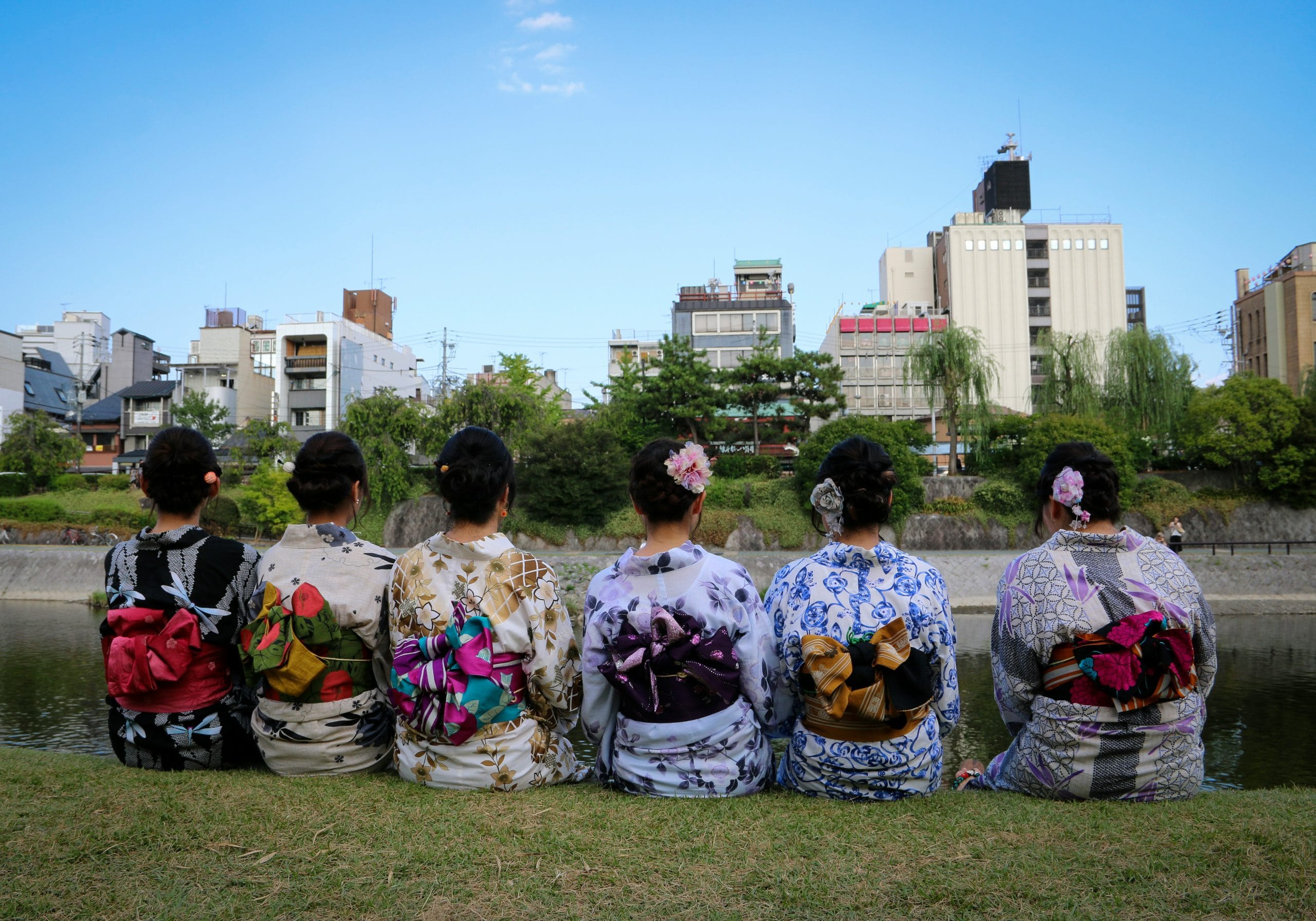
The first thing many visitors notice in Japan is not what is there — but what isn’t.
No neon outfits shouting personal philosophy.
No buildings screaming for attention like toddlers on sugar.
No coworkers announcing their individuality through motivational mugs or aggressively quirky socks.
Instead, there is harmony. Visual calm. A collective agreement to not turn the volume knob past a polite medium.
Japan, quite deliberately, designs for the group.
And once you start seeing it, you can’t unsee it — in clothing, architecture, offices, even the choreography of how people stand, walk, and wait.
Fashion: The Elegance of Blending In
Japanese fashion has a global reputation for being experimental — and it is. But here’s the quiet twist: even the boldest Japanese styles are often cohesive rather than attention-seeking.
Look closely on a Tokyo morning train platform. The palette is restrained: navy, black, beige, gray, soft olive. Silhouettes are loose, layered, forgiving. Logos whisper instead of shout.
Fashion here is less about who am I and more about how do I exist comfortably among others.
Uniforms — school, company, service — play a huge role. They are not about suppression; they are about removing friction. When everyone is dressed within the same visual language, the room relaxes.
In the West, clothing often functions as a résumé of personality:
Creative. Confident. Unapologetically me.
In Japan, it’s closer to:
Reliable. Thoughtful. Aware of context.
Neither is superior. They’re simply different design philosophies — like jazz improvisation versus a perfectly rehearsed orchestra.
My grandmother once told me, adjusting my coat collar before school,
“If your clothes are louder than your manners, something is wrong.”
I didn’t understand at twelve. I understand very well now.
Architecture: Quiet Buildings, Loud Intentions
4
Japanese architecture rarely asks for applause.
Buildings tend to recede rather than dominate — neutral facades, clean lines, an almost apologetic relationship with their surroundings. Even striking contemporary structures often bow visually to their neighborhood.
This is not accidental. It’s cultural.
Space in Japan is shared emotionally as well as physically. A building that screams for attention disrupts the mental harmony of the street. It’s like someone talking too loudly in a quiet café — technically allowed, socially questionable.
Contrast this with Western “statement architecture,” where buildings are branded like personalities:
I am bold. I am innovative. I am different.
In Japan, architecture asks:
How do I belong here?
The scholar The Chrysanthemum and the Sword famously explored how Japanese culture prioritizes social harmony over individual assertion. While the book is dated, the observation still echoes in concrete, glass, and wood across the country.
Even signage follows this logic. Fonts are legible, colors controlled, information layered logically. The goal is clarity, not persuasion. No flashing arrows yelling LOOK AT ME. Just gentle guidance — like a well-designed train station that somehow directs millions of people without anyone raising their voice.
Office Culture: The Power of the Unremarkable Desk
4
Japanese offices are masterclasses in visual restraint.
Desks are uniform. Supplies standardized. Personal items minimal — maybe a family photo, a small plant, a discreet good-luck charm. No lava lamps. No ironic posters. No “Girlboss” typography.
This isn’t because individuality is forbidden. It’s because work is not where individuality performs.
In Western office culture, personal branding often seeps into everything:
My workspace reflects my creativity.
My job reflects my identity.
In Japan, your work reflects your reliability within the group. Standing out visually can read as standing apart — and that’s rarely the goal.
Sociologist The Anatomy of Dependence described the Japanese concept of amae — the expectation of mutual reliance. In office life, this translates into subtle coordination: matching effort levels, shared rhythms, collective responsibility.
Harmony isn’t passive. It’s actively maintained — like tuning an instrument so it doesn’t disrupt the orchestra.
Behavior: Choreographed Consideration
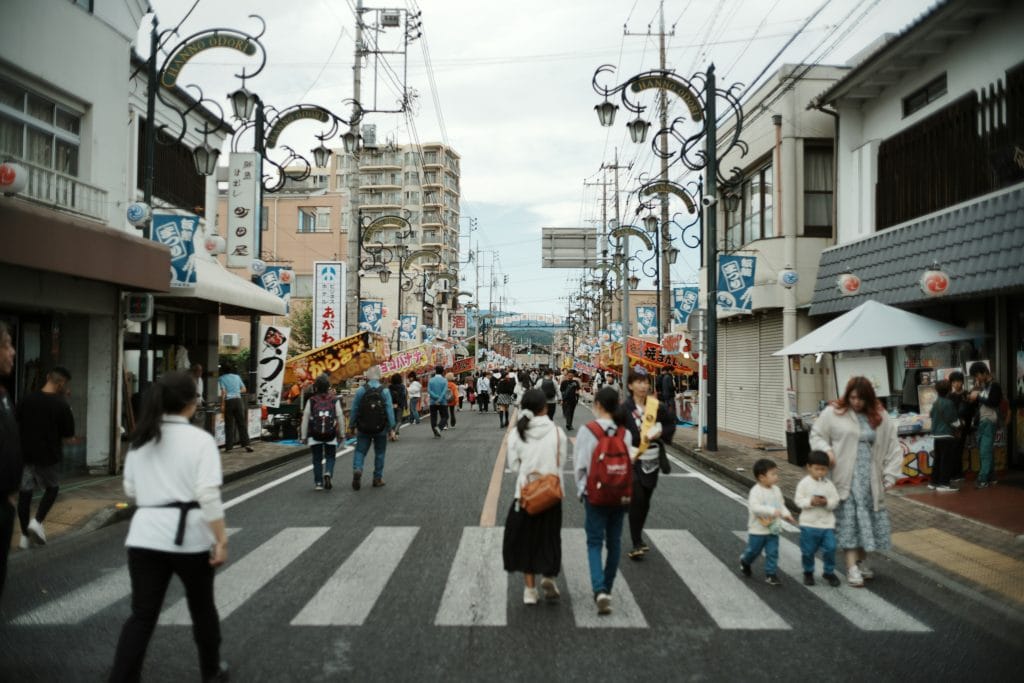
The collective design philosophy extends to the body itself.
People queue neatly even when no one is watching. Phone calls are muted or avoided on trains. Gestures are economical. Voices calibrated to the room.
Standing out behaviorally — speaking loudly, interrupting, claiming space — creates social noise.
In the West, assertiveness is often framed as confidence. In Japan, awareness is the higher virtue.
There is an unspoken belief that if everyone restrains themselves slightly, the entire group becomes freer.
I once watched a foreign visitor bow enthusiastically — too deeply, too long — to a cashier who froze in polite confusion. Excessive individuality can be just as disruptive as rudeness. Harmony lives in calibration.
Muted Design as Cultural Technology
Muted colors, uniform silhouettes, minimal signage — these are not aesthetic accidents. They are cultural technologies designed to reduce friction in dense, complex environments.
Tokyo is one of the largest cities on Earth, yet it operates with remarkable smoothness. That doesn’t happen through rules alone. It happens through shared visual and behavioral restraint.
Western cities often celebrate friction as energy:
Chaos equals creativity.
Japan treats friction like static:
Reduce it, and the signal becomes clearer.
This doesn’t mean Japan lacks self-expression. It simply relocates it.
Expression emerges in micro-details: fabric texture, seasonal color shifts, word choice, craftsmanship, food presentation, humor. The quieter the system, the more meaningful the deviation.
The Subtle Rebellion of Restraint
Here’s the irony Western observers sometimes miss: designing for the collective is not about erasing the self.
It’s about trusting that the self doesn’t need to announce itself constantly to exist.
In a culture where everyone is shouting, silence becomes radical. In a culture where harmony is expected, individuality becomes powerful precisely because it’s rare and contextual.
Japan doesn’t reject individuality — it edits it.
And like any good editor, it knows that what you remove often matters more than what you add.
So if you come to Japan expecting fireworks of self-expression, you may initially feel underwhelmed.
But stay a little longer.
Watch how people dress for the season, not the spotlight.
Notice how buildings listen to their streets.
Observe how offices hum quietly instead of roaring.
You may discover that not standing out is its own sophisticated art form — one perfected over centuries, refined through daily life, and practiced beautifully by millions who understand that harmony, when designed well, is not a loss of self…
…it’s a shared luxury.
ChatGPT can make mistakes. Chec
