
There’s a kind of quiet choreography that unfolds on the platforms of Tokyo’s Shinjuku Station every morning. Hundreds of commuters line up exactly where the train doors will open, feet placed just so, eyes forward, shoulders still — and then, at the precise moment of arrival, a seamless ballet begins: people step on, people step off, no gaps, no jostling, no drama. It feels almost mystifying to a visitor raised in a culture where “everybody for themselves” queuing often looks more like organized chaos.
So what’s going on here? Is it discipline? Tradition? Social pressure? Something deeper? The answer lies at the intersection of fairness, predictability, and a cultural logic rooted in harmony. And this isn’t just polite behavior; it’s a form of social intelligence that has been cultivated over generations.
Line Culture as a Visible Contract
At its most basic level, a queue is a visible agreement — a shared understanding that everyone who arrives first will be served first. But Japanese queuing runs deeper than mere logistics. In Japan, forming a line isn’t a grudging concession to necessity; it’s a collective affirmation of fairness. The presence of an orderly line makes turn-taking transparent to everyone involved, removing the need for verbal negotiation or dominance displays.
Here’s the subtle but powerful thing: people don’t line up because someone told them to — they do so because there’s an implicit trust that everyone else will honor the same social contract. A queue in Japan isn’t enforced by enforcers or signs — it’s sustained by mutual understanding.
This subtle contract resonates with larger cultural values where respect for the group and fairness carry weight. Research comparing moral dimensions across cultures has shown that Japanese communication tends to emphasize fairness and ingroup harmony more than in many Western contexts.
Fairness, Not Competition
In many Western queuing cultures, a line often becomes a battleground. You’ll hear shouts of “I was here first!” or see the subtle elbow nudge from someone inching up the rope barrier. But in Japan, cutting ahead is social folly — not merely rude, but emotionally awkward.
Why? Because the act of cutting the line isn’t just a personal gain — it disrupts the harmony of the group. Japanese social norms prioritize wa (和) — a concept often translated as harmony or concord — above displays of individual assertiveness. Queueing enforces this harmony; it’s literally the shape group cooperation takes in public spaces.
This focus on group cohesion isn’t accidental. From childhood, students are taught manners that emphasize taking turns, respecting others’ space, and contributing to a calm public environment. By the time adulthood arrives, orderly queuing doesn’t feel like a constraint — it feels like common sense.
Predictability and the Mental Comfort of a Line
Predictability is another quiet force behind Japan’s queue culture. A line makes the future legible: you know where you are, what’s coming, and when it’s your turn. In a world where train schedules run to the second and delay announcements often include apologies from station staff, predictability isn’t just efficient — it’s culturally prized.
Think about it: when everyone lines up and respects that order, the next person moving forward becomes almost automatic. There’s no negotiation, no agitation, no anxious jockeying for position. It creates a mental ease — even when the wait is long.
In contrast, queuing elsewhere can feel unpredictable: people cut in front, employees don’t signal who’s next, lines snake without shape, and uncertainty grows. That uncertain energy triggers stress, impatience, and conflict. The Japanese queue is the cultural antidote to that uncertainty.
Humility as Social Currency
There’s a Japanese concept called omoiyari (思いやり): a kind of intuitive empathy that anticipates and respects others’ needs before they’re voiced. Standing quietly in line is an outward expression of this inner value. It conveys, non-verbally, “I acknowledge your time. I respect your turn.”
More than that, there’s a cultural distaste for meiwaku — causing trouble or inconvenience to others. In Japan, breaking a line feels like creating a ripple of discomfort that temporarily disturbs everyone else’s calm. Even if you gain five seconds, you lose social harmony — and that loss is felt more keenly than the gain.
In many Western cultures, assertiveness and self-advocacy are socially validated — queuing often rewards the ones who push just a little harder. But in Japanese settings, restraint is the social currency. It’s not weakness — it’s consideration.
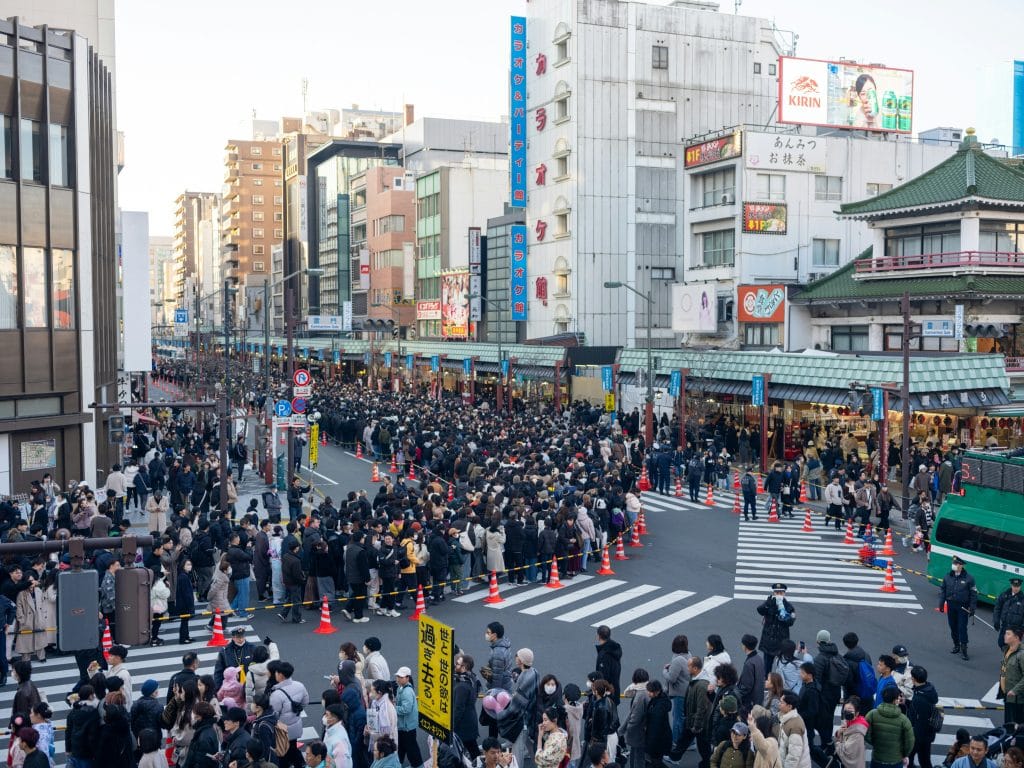
Harmony in Practice: Trains, Elevators, Cafés
Let’s zoom into how this plays out in everyday Japan:
Train Platforms
Painted markings indicate exactly where doors will open. People queue in neat lines that match these markings. When the train arrives, passengers exit first from the center space, and only then do queued riders step aboard — creating a smooth flow that minimizes collision and maximizes speed.
Elevators
At office buildings or shopping centers, people form a queue before the elevator arrives. There’s no frenzy, no jockeying for position. When the doors open, everyone takes their turn based on arrival order — even when space is limited and time is precious.
Shops and Cafés
Whether you’re lining up for lunch at a ramen stall (where popularity can be literally measured by the queue length) or waiting at a convenience store register, people form single-file lines that respectfully preserve personal space and order.
In all of these spaces, there’s no need for a bouncer, no need for ropes, no need for a countdown — the line just happens. And it works. That’s the astonishing part.
A Cultural Contrast: Western Queues
If you’ve ever stood in line in New York, Paris, or Cairo, you know how different the vibe can be. Someone eventually breaks in front. Someone else shifts into the “fastest” line. People loudly complain. Some try to claim informal “spots” for friends. Queue theory in many Western contexts often assumes individual utility maximization — the fastest, smartest, or boldest gets ahead. It’s a game, not a contract.
By contrast, Japanese queuing assumes a baseline level of cooperation. The system doesn’t rely on enforcement; it relies on internalized norms. In many Western countries, social norms about queuing can be weaker, more varied, and less tied to collective values of harmony and respect.
This isn’t to say Western cultures don’t value fairness — just that fairness often shares space with competitiveness, assertiveness, and personal advantage. The Japanese queue, on the other hand, almost feels like a shared meditation on patience.
What It Teaches Us
When I watch a Japanese queue unfold — at 8 a.m. on a rainy platform, or outside a tiny bakery early on a Sunday — there’s a calm logic to it that goes beyond efficiency. It’s about generosity of space and time, an unspoken empathy that says:
I will wait my turn, and I trust that you will too.
In a world that often prizes speed and competition, the Japanese queue is a reminder that fairness and predictability can be beautiful. Not as abstract ideals, but as everyday actions — billions of tiny agreements that whisper: “We see you. We respect you. When it’s your turn, step forward.”
Maybe that’s the real lesson: harmony isn’t just something you feel — it’s something you stand in line for.
