

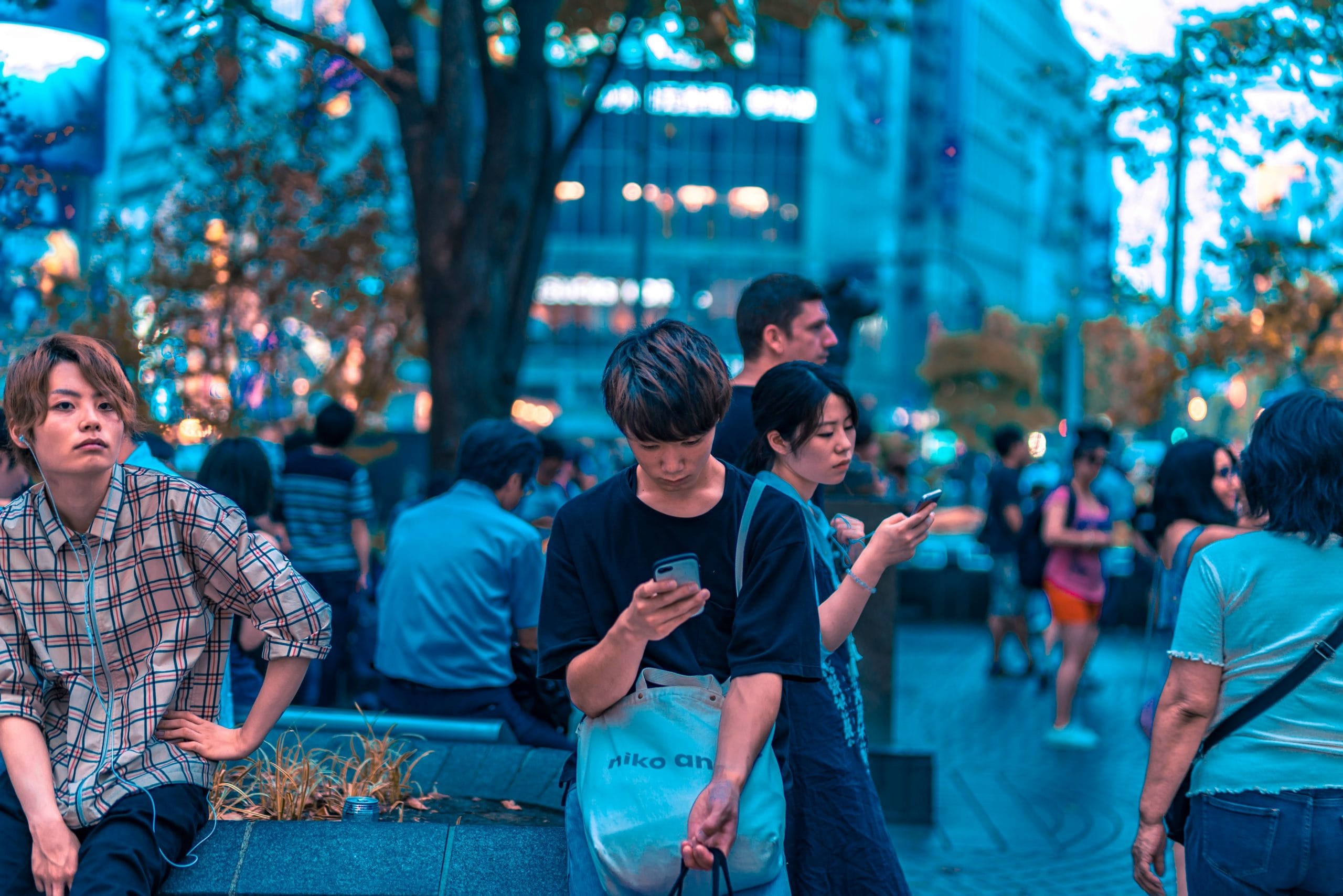
There’s a small, slightly comical tension that lives in Tokyo’s streets: a salaryman tapping a tiny, perfectly coiffed flip phone with deliberate thumbs while a delivery drone hums somewhere above and a Shinkansen — which looks and sounds like a polished silver samurai — slices past at 300 km/h. Japan’s tech story isn’t a single arc from primitive to perfect; it’s a collage. We keep the cozy old things and build spectacular new ones beside them. This isn’t contradiction so much as taste, trust, and a national sense of what “works.”
Let’s start with the obvious surprising one: flip phones. The cheerful little clamshells — the ガラケー, “garakei” (Galapagos keitai) — persisted long after smartphones went global. They’re small, tactile, and almost stubbornly uncomplicated. For many older users they are ergonomically gentler: large buttons, a predictable interface, excellent battery life and an absence of the endless permission pop-ups that make modern devices feel needy. For young people, some models are a fashion statement, a wink at retro. But more important than nostalgia is compatibility: many Japanese services and websites were designed around the peculiarities of these phones; they fit into institutional life the way a familiar chopstick fits a practiced hand. Scholars have even described this as a case of domestic specialization — devices that evolved to match local practices rather than global ones.
Then there’s the national romance with paper’s cousin, the fax machine. Mention it in a dinner conversation and you’ll get that soft, incredulous chuckle from foreigners — only to be met by earnest explanations about signatures, legal precedent, and the comforting whirr of certainty when a page prints. Faxes survived because governments and corporations wrote rules and process flows that used them; when a law or procedure explicitly required an inked, dated page, the fax became a kind of bureaucratic badge of legitimacy. Digital reformers fought this for a decade; the Digital Agency’s push to remove floppy disks from government practice made headlines when it finally declared victory — but that victory came after years of incremental policy and a few high-profile digital fails that had citizens asking whether speed mattered more than safety. The result: old tech didn’t persist because people loved it; it persisted because institutions trusted it.
Cash is another old-school darling. Walk into a neighborhood izakaya or tiny shrine-side vendor and you’re more likely to see notes traded than contactless taps. This isn’t romanticism only; it’s also about accessibility and dignity. Bank of Japan polling shows a sizable chunk of the population finds cashless systems complicated or inconvenient, and many older citizens simply feel safer with physical money in their hands or stored in a household envelope system that has lived through generations. Japan’s policy push toward cashless payments has moved the needle — slowly — but the cultural infrastructure of convenience stores, part-time wage norms, and the comfort value of tangible exchange means you can have a thriving digital wallet economy and a stubbornly cash-rich one at the same time. Trust, once again, is the hinge.
So why keep the old instruments when Japan also builds the future? Because reliability is aesthetic here. The nationwide obsession with timetables — the ritual of trains arriving to the minute — isn’t merely punctuality. It’s an expression of collective faith: systems that work reliably, repeatedly, quietly. This philosophy is visible in the Shinkansen’s engineering elegance and in experiments with driverless trains and private 5G networks that promise even tighter control over latency and safety-critical operations. The country invests heavily in very visible, very impressive public infrastructure: maglev lines, automated platforms, and train technology that feels like set design for a sci-fi film. But those big, public marvels are built on layers of small, trusted practices: paper logs, manual sign-offs, human eyes double-checking sensors. High-tech drama sits atop low-tech scaffolding.
Robots illustrate the duality beautifully. In nursing homes and factories you’ll see humanoid assistants, wheeled helpers, and clever cobots working next to humans. They are practical responses to demographic realities: an ageing population and a dwindling workforce. Robots are not a lifestyle boast; they’re a policy imperative dressed in LED lights. But this mechanized presence doesn’t displace the analog entirely. Where tenderness is required — an old hand to hold, a voice conversation — human caregivers still matter. Robots handle repetitive, heavy, or dangerous tasks; humans keep the humanity. The point isn’t technology for spectacle but technology as social glue, calibrated to preserve dignity while solving labor gaps.
What ties all of these threads together is cultural comfort and institutional trust. In Japan, the decision to adopt or abandon a technology is rarely just personal. It’s social. Family norms, corporate procedures, municipal regulations and the gentle pressure of “how things are done here” matter. The Japanese phrase “当たり前” (atarimae) — what’s taken for granted — drives adoption patterns. If a system is atarimae, people can plan their lives around it. The more a new technology collides with the atarimae, the slower and more cautious the uptake.
Reliability is another currency. Many people will choose an older method if it offers fewer surprises. A fax printout, a folded banknote, a phone that refuses to pry into your data — these are predictable, legible, and therefore trustworthy. For businesses and local governments, legal predictability matters. When a process demands consistency across millions of citizens, the known risk of a decades-old practice can outweigh the hypothetical benefits of a newer one.
Finally, institutional trust — or the lack of confidence in the institutions behind new tech — shapes behavior. Japan’s digital rollout has had theatrical missteps: a failed contact-tracing app here, messy data migrations there. Each glitch is magnified because expectations of precision are high; when a tool promised as flawless fails, it sets public skepticism like setting cement. Policy fixes and improved digital governance help, but trust rebuilds slowly, often via small, incremental wins rather than a single dramatic leap.
And yet, there is no technophobic romanticism here. Japan loves shiny things. The promise of 5G isn’t a threat to the flip-phone holder; it’s the connective tissue for driverless trains, real-time remote surgery, and factories that can coordinate thousands of parts without the blink of an eye. The country’s approach is curatorial rather than wholesale: keep the reliable, retire the redundant, and architect the future where it counts. That leaves room for a grandmother to buy a cheap, cheerful phone and a startup in Akihabara to prototype an exoskeleton that helps a delivery worker carry heavy loads.
If you’re a visitor, this mix can feel charmingly dissonant. You can pay for a ramen bowl with cash that smells faintly of soy and then ride a train whose doors close with a soft pneumatic whisper that seems engineered to calm. You could check into a hotel where the front desk is staffed partly by robots and partly by humans who understand the exact right level of politeness needed to reassure a confused tourist.
In the end, Japan’s techno-cultural dance is pragmatic and humane. It recognizes that technology isn’t purely progress; it’s practice. A tool becomes useful when it fits someone’s life, and in Japan those lives are braided with history, regulation, and small social rituals. So the next time you see a flip phone under a neon sign, don’t be baffled. Think of it as an accessory in a larger ecosystem — a place where the old keeps its dignity and the new keeps its promises.
If you want to read more about the specifics behind these habits — the academic work on Garakei’s evolution, the Bank of Japan’s public survey on payment preferences, the Digital Agency’s push to modernize bureaucracy, GSMA’s 5G reports, or reporting on robots in elder care — I’ve pulled together a few authoritative pieces that explain the statistics and the policy moves shaping this uniquely layered technoscape.
