

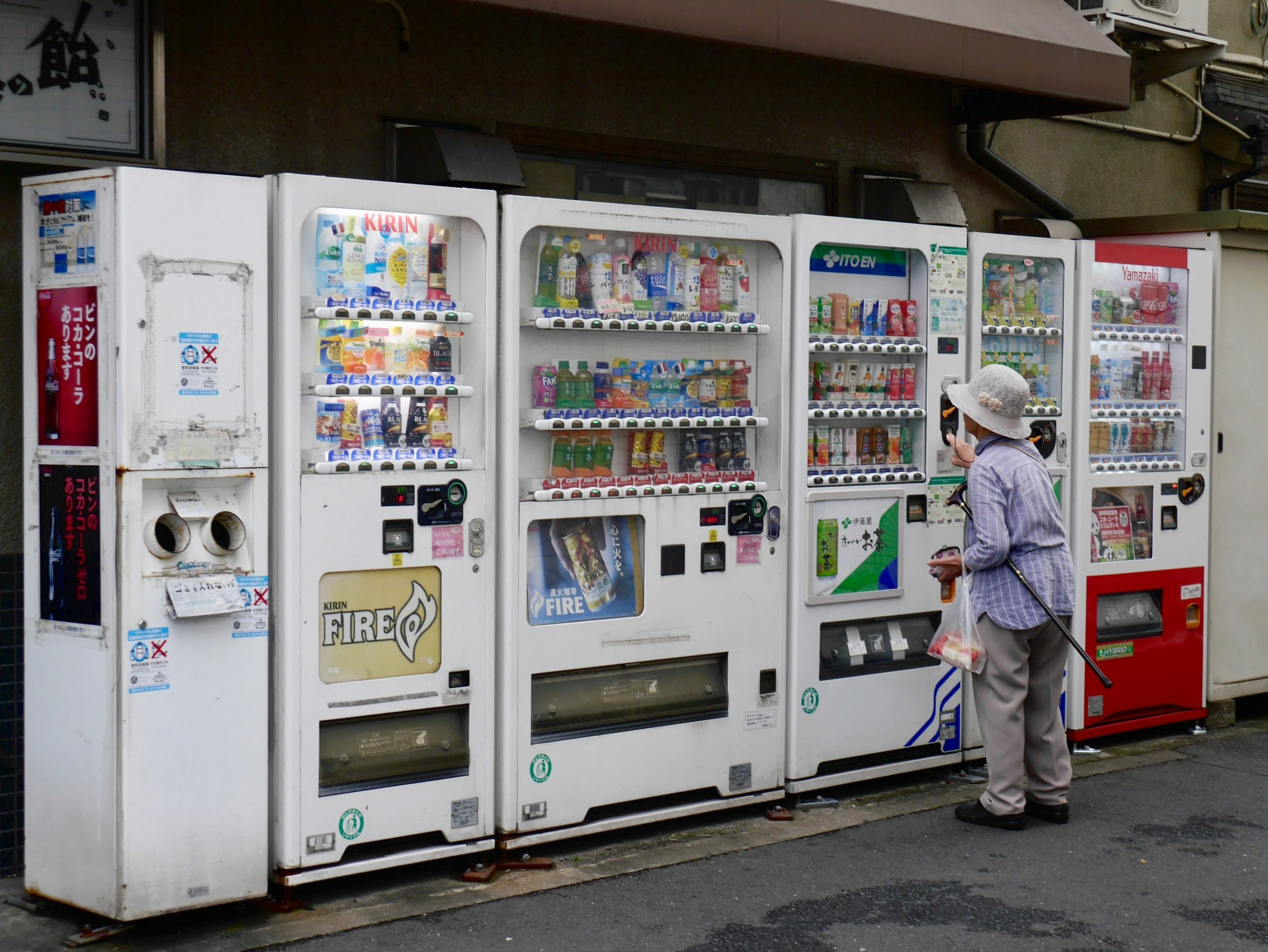
At 2:17 a.m., under the polite hum of fluorescent lights, I am standing in a convenience store debating two onigiri.
One is salmon. Reliable. Sensible.
The other is something seasonal, experimental, possibly engineered by a committee that understands both rice chemistry and human weakness.
Behind me, a salaryman pays without breaking his stride. He doesn’t look at the register. He doesn’t even slow down. His phone tilts, a soft chime answers, and he disappears back into the night like a very well-dressed ghost.
This is Japan’s convenience store—konbini—at work.
It is undeniably high-tech.
And yet, somehow, it never feels cold.
That’s the magic worth examining.
The Technology You Barely Notice
In the West, technology often announces itself.
Self-checkout machines beep impatiently. Screens flash warnings. A robotic voice scolds you for placing a bag “in the unexpected area,” a phrase that has ruined many otherwise good afternoons.
In Japan, technology prefers to whisper.
Automatic Payments That Don’t Perform
Most konbini now support multiple forms of cashless payment: IC cards like Suica and PASMO, QR systems like PayPay and LINE Pay, credit cards, and increasingly, biometric authentication pilots.
But the key detail is this:
the system adapts to the customer, not the other way around.
The payment terminal is angled just enough. The screen brightness adjusts. The sound feedback is gentle—closer to a confirmation than a command.
According to Japan’s Ministry of Economy, Trade and Industry (METI), widespread IC card adoption succeeded precisely because it reduced “cognitive and physical transaction friction” rather than adding new steps. The goal was not innovation for spectacle, but innovation for flow.
In other words:
You never feel like you’re “using technology.”
You feel like you’re passing through it.
Heated Floors, Warm Food, Calm Bodies
Let’s talk about temperature.
Japanese convenience stores are climate-controlled with the emotional intelligence of a grandmother.
In winter, the floor near the register is slightly warmer. Not enough to notice consciously—just enough that you don’t rush. The oden pot gently steams. The nikuman warmer glows like a small hearth.
This is not accidental.
Studies from retail design firms like Nomura Research Institute have shown that customers linger longer—and make calmer decisions—when thermal comfort is localized rather than aggressive. Instead of blasting heat everywhere, konbini use zoned warming: counters, food cases, entrances.
Compare this to many Western convenience stores, where self-checkout zones feel like airport security checkpoints—bright, cold, vaguely accusatory.
Japan understands something quietly profound:
Warmth is a form of hospitality, not a luxury.
Inventory Systems That Think in Hours, Not Weeks
One reason konbini feel alive is that the shelves are never frozen in time.
Products rotate constantly. Not seasonally—hourly.
Behind the scenes, advanced inventory management systems track purchasing patterns by:
- time of day
- weather
- nearby events
- even train delay data
Seven & i Holdings (parent company of 7-Eleven Japan) has openly discussed how its POS systems allow individual store managers to adjust orders three times a day. Morning commuters want light breakfasts. Lunch crowds want volume. Late night wants indulgence.
This is technology as listening.
In many Western systems, inventory is centralized and optimized for logistics efficiency. In Japan, it is optimized for context.
That’s why your favorite snack disappears for two weeks and then returns, slightly improved, like a friend who went to therapy.
Product Rotation as Cultural Conversation
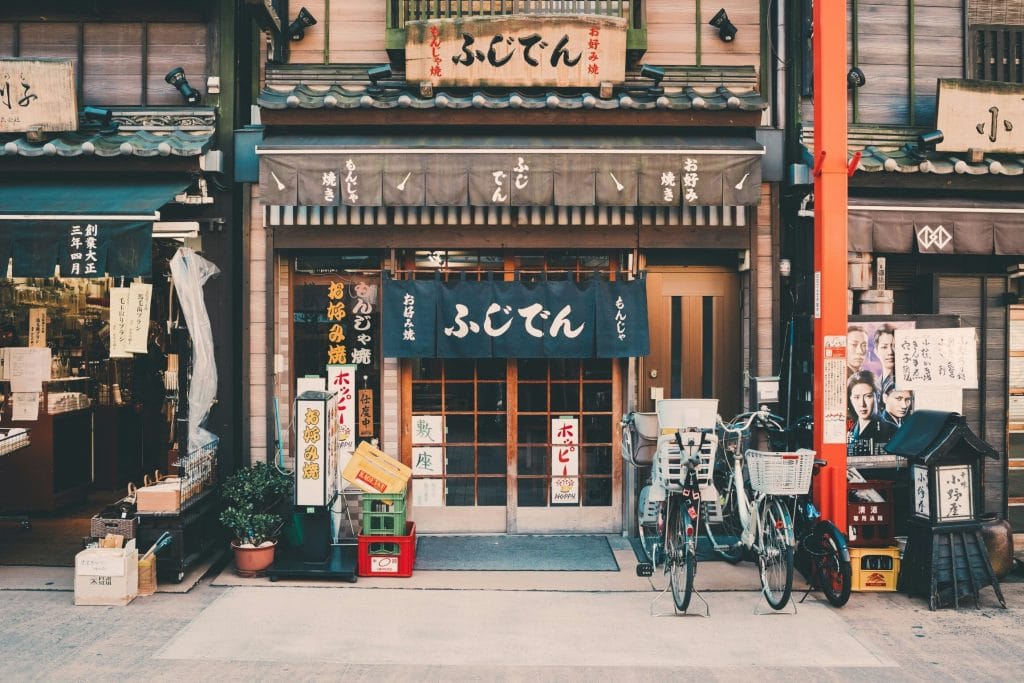
Japan’s product rotation cycles are not just operational—they are cultural.
Limited editions. Regional flavors. Seasonal packaging that lasts exactly long enough to be missed.
This constant change keeps customers curious without overwhelming them. Familiar staples anchor the experience; rotating items provide gentle novelty.
Retail analysts at Mitsubishi UFJ Research have described this as “controlled surprise”—a balance between trust and interest.
In the West, self-checkout systems often push efficiency at the expense of engagement. You scan. You pay. You leave.
In Japan, the store itself participates in a conversation with you:
It’s colder today. Maybe try this.
It’s cherry blossom season. Here’s something pink and unnecessary.
Technology enables that conversation—but never interrupts it.
Why Japanese Self-Checkout Feels Less Hostile
Japan does have self-checkout. But notice how it’s positioned.
It’s usually optional.
Staff remain nearby, visible, human.
The machines are quieter, slower, more forgiving.
The assumption is not that you might steal—but that you might need help.
Western self-checkout often feels like unpaid labor combined with suspicion. Cameras loom. Alarms threaten. You feel watched and slightly guilty for reasons you can’t articulate.
Japanese design philosophy—rooted in concepts like omotenashi (thoughtful hospitality)—starts from trust.
A 2022 consumer behavior study by the Japan Productivity Center found that customers reported less stress using semi-automated checkout when staff presence was maintained, even if interaction was minimal.
Efficiency is important.
Dignity is more important.
The Human Face Behind the Screen
Here’s the detail outsiders miss:
Technology in Japanese convenience stores is designed to protect human rhythm, not erase it.
Cashiers are trained to maintain eye contact, even when automation handles the transaction. Receipts are handed—not ejected. Apologies are offered when machines pause, even though the pause benefits accuracy.
The system absorbs friction so people don’t have to.
My grandmother used to say that good service is when effort is invisible but care is obvious.
Konbini perfected that philosophy at scale.
A Late-Night Comparison
Once, in New York, I watched a man argue with a self-checkout machine for five full minutes over a bag of oranges. The machine won.
In Tokyo, at 3 a.m., I watched a tired nurse tap her phone, receive a warm coffee, and bow slightly—to no one in particular.
That bow wasn’t for the machine.
It was for the experience.
Japan’s convenience stores feel high-tech without feeling cold because technology there knows its place.
It supports.
It softens.
It steps back.
And maybe that’s the lesson Western retail keeps missing:
The future isn’t louder screens or faster beeps.
It’s quieter systems that let people stay human—
even when choosing between two onigiri at 2:17 in the morning.
